Weather radios
How to program S.A.M.E. county codes on a NOAA weather radio
An unprogrammed weather radio wakes you for storms three counties away and teaches you to switch it off. Fifteen minutes with one six-digit code turns it into a sentry that only speaks when the warning is yours.
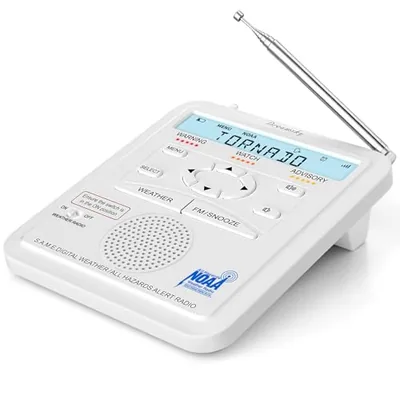
What S.A.M.E. actually is
NOAA Weather Radio transmits around the clock, but most of what it says is routine forecast. The part you bought the radio for, the warning at 2 a.m., arrives wrapped in a short digital header that names the message type, the counties affected and when it expires. That header system is Specific Area Message Encoding, S.A.M.E. for short.
A radio with S.A.M.E. support listens to those headers silently. When one names a county you programmed, the radio wakes, sounds its alert tone and plays the message, when it names any other county, the radio stays quiet. Without programming, the radio treats the whole transmitter footprint as its business, and that footprint is large.
The National Weather Service, which runs the system, puts the consequence plainly on its programming page.
«After buying an NWR SAME receiver, you must program your county, parish, independent city or marine area into the radio.»
National Weather Service, «Using NWR SAME», read 24 August 2026 · source
You have alerts on your phone. Why a radio at all?
Wireless emergency alerts are real and worth keeping on, and the radio is not their rival, it is their backstop. Phone alerts arrive over cell networks that share fate with the power grid, arrive silenced when the phone is on do-not-disturb, and arrive nowhere when the phone is charging in the kitchen. The radio has one job, its own power, and no notification settings to lose a fight with.
There is also a coverage difference in what gets sent. The weather radio carries the full stream of watches, warnings and statements for your programmed counties, read in full, repeated, with context. A phone push is a headline, at 2 a.m. with hail starting, the difference between a headline and a voice explaining the polygon matters.
The failure mode the radio exists for is precisely the compound one: the storm that takes the power that takes the cell site. Nights like that are rare. They are also the only nights any of this equipment is truly for, and rare-night equipment must not depend on the systems the rare night removes.
None of this requires fear as a purchase motive. It requires the same reasoning as a smoke alarm: cheap, single-purpose, always on, and boring for years by design.
Finding your county's six digits
Every US county, parish, independent city and marine area carries one six-digit code. The first digit is almost always zero, the next two identify the state, the last three the county. You do not need to memorize the anatomy, you need the six digits for the places you sleep and the places family sleeps.
Our finder page hands you the code in two clicks: pick the state, pick the county, read the digits, print the card. The list behind it is the National Weather Service's own table, and if you prefer the source, NWS also gives the codes by phone and on its site.
Write the code down before you touch the radio. Programming goes smoothly exactly in proportion to how little you are looking things up mid-menu.
Large counties sometimes surprise people the other way: a single code covers the whole county, city and rural corners alike, and there is no per-town granularity to hunt for. Some NWS offices do issue partial-county alerting for a handful of oversized western counties, but the code you program is still the county code, the partial detail lives in the message text.
Marine areas carry their own codes for boaters, listed separately by NWS. If your life includes a slip or a shore cabin, treat the marine zone as one more deliberate subscription, with the same restraint the county list deserves.
«To program NWR SAME receivers with the proper county(s) and marine area(s) of choice, you need to know the 6-digit SAME code number.»
National Weather Service, «Using NWR SAME», read 24 August 2026 · source
The programming steps, unhurried
On our desktop NOAA radio the sequence is five steps. Hold MENU until the display blinks. Arrow to SAME SET and confirm with SELECT. Enter the six digits with the arrows, one position at a time, and confirm. Add a second or third county the same way if you want neighbors covered. Exit the menu and the radio is armed.
Two habits make it painless. Do it in daylight at a table, not at midnight on a nightstand, and say each digit aloud as you enter it, the way pilots read checklists. The keypad is small, the ritual catches the slip.
If the menu ever confuses you, unplug for ten seconds, put the batteries back and start over. Programming is stored, not fragile, and a restart costs nothing but pride.
Radios from other brands differ in button names, not in substance: somewhere there is a menu, somewhere a SAME slot, somewhere a confirm. The card our finder prints is deliberately generic on purpose, six digits and the channel, so it serves whatever receiver ends up on the shelf next decade.
One more habit from people who do this professionally: after confirming, back out of the menu fully and let the display return to its idle state before you judge success. Half-exited menus are where phantom programming failures live.
The channel matters as much as the code
S.A.M.E. rides on a broadcast channel, and your radio must be tuned to the transmitter that actually covers your county. Seven weather frequencies exist, the right one is listed next to your county in the same NWS table our finder uses.
Do not chase the loudest channel. NWS warns specifically against tuning to a clearer station that is not designated for your area: strong signal from the wrong transmitter means alerts for the wrong counties, and silence for yours.
Reception itself has honest limits, and the service says so in plain numbers.
«NWR service to a county depends on reliable signal reception, which typically extends in about a 40 mile radius from the transmitter, assuming level terrain.»
National Weather Service, «NWR Specific Area Message Encoding (SAME)», read 24 August 2026 · source
Prove it worked: the weekly test
NWS offices transmit a required weekly test, typically midweek around midday local time. A programmed radio treats it like a real alert: tone, message, done. Hearing one is the proof your digits took.
After programming, either wait for the scheduled test or use the radio's own test button to rehearse the household: this is the sound, this is where the radio lives, this is the volume it will use at night. A drill heard once in daylight is far less frightening at 3 a.m.
When a real alert arrives, the sequence is the one the service describes.
«A programmed NWR SAME receiver will turn on for that message, with the listener hearing the 1050 Hz warning alarm tone as an attention signal, followed by the broadcast message.»
National Weather Service, «Using NWR SAME», read 24 August 2026 · source
How many counties to program, honestly
The temptation is to add every county around you, and the result is a radio that wakes nightly for weather that never arrives. Storms travel, warnings are drawn county by county precisely so you can subscribe narrowly.
Our rule: your county always. Add one upstream neighbor if severe weather in your area reliably arrives from one direction and you want the extra lead time. Add the county where a parent or a cabin sits only if you would act on that alert at night, and remember the radio will wake you for it.
Fewer, deliberate codes keep the alert meaning what it must mean: get up now. That meaning is the whole product.
Batteries, placement and the radio's night job
The desktop radio lives plugged in with batteries behind it, so an outage, which so often rides along with the storm, does not silence the sentry. Check the cells when the smoke alarm gets its yearly change and the pair of habits maintains itself.
Placement is antenna work: near a window helps, buried behind the TV hurts, and the telescoping antenna extended beats every clever angle of a collapsed one. If reception at home is marginal, try the far side of the house before concluding anything, forty miles of theory meets local terrain in practice.
Volume deserves one decision: loud enough to cross a closed bedroom door. A warning you sleep through spent its technology for nothing.
Where the hand-crank radio fits in the same plan
The desktop S.A.M.E. radio is the alarm, the crank radio is the aftermath tool. It self-charges from crank, solar strip or USB, pulls AM, FM, shortwave and the weather band, and carries a power bank that can push real charge into a phone when outlets are a memory.
It does not do S.A.M.E. filtering, and that is fine: during the event you want the continuous broadcast anyway, and you will be awake. Program the sentry, stage the crank radio with the flashlights, and the two cover the night and the day after between them.
Households in storm country that own both stop improvising. That is the entire pitch, and it is the honest one.
The five programming mistakes we actually see
Mistake one: programming the code and skipping the channel. The radio dutifully filters headers on a frequency that never carries your county, and the first missed watch gets blamed on the hardware. Code and channel are one task, our card prints them together.
Mistake two: the neighboring state's twin county. Many county names repeat across state lines, and picking Jefferson in the wrong state is a one-click error with a six-digit disguise. The finder shows the state above the county list for exactly this reason, read both lines before you type.
Mistake three: programming ALL as a shortcut. Some radios accept an any-county mode, and it turns the sentry back into the fire hose you bought S.A.M.E. to escape. If you want everything, the plain broadcast already gives it to you without alarm tones.
Mistake four: entering five digits and letting the radio pad the sixth. If the display does not show all six positions filled the way the card reads, clear the slot and start it again, a truncated code matches nothing and fails silently.
Mistake five: never running the test. An unproven programming job is a hypothesis. The weekly test costs one lunchtime minute and converts it into a fact, which is the only currency worth holding in preparedness.
The whole procedure on one card
Look up the six digits on the finder page and print the card. Tune the radio to the channel listed for your county. Program the code, add at most one deliberate neighbor, and run the test so the household has heard the sound once.
Load fresh batteries behind the wall power, place the radio high and near glass, set the volume to cross a door, and put the printed card under the radio for the day you move or the day someone else has to redo this.
Fifteen minutes, once. After that the radio is the quietest thing you own, right up until the night it is not, which is the point.
And when you move, the ritual repeats: new county, new code, new channel, new test. Put it on the same list as changing the locks. The radio does not know you moved, and a sentry watching the old street is the quietest failure in this whole guide.