Timekeeping
Auto-set vs atomic time: what each DreamSky model actually does
Two very different technologies wear similar marketing clothes. One is a convenience: the time arrives in the box. The other is an antenna: the clock corrects itself nightly from a government transmitter. Confusing them causes returns, separating them takes five minutes.
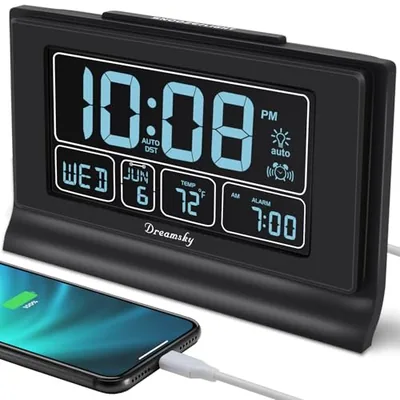
Why the two get confused, and who profits
Somewhere along the line, clock listings started using self-setting, auto-set, radio-controlled and atomic as if they were seasoning. A buyer reads any of them and hears the same promise: I will never set this clock. The technologies underneath are unrelated, and only one of them involves radio.
Auto-set is memory. The factory loads the current time, a backup cell keeps it counting in the warehouse, and out of the box you pick a time zone. Atomic is communication: the clock carries a receiver for WWVB, a 60 kHz government time station, and corrects itself against it, typically overnight.
| Model | How it gets the time | DST | After a long blackout |
|---|---|---|---|
| Auto-Set Alarm Clock with Date & Temperature | Preloaded at the factory, you pick a zone | Automatic | Settings held by backup cells |
| Auto-Set Alarm Clock, 5-Inch Display | Preloaded at the factory, you pick a zone | Automatic | Settings held by backup cells |
| Auto-Set Alarm Clock with Day of Week | Preloaded at the factory, you pick a zone | Automatic | Settings held by backup cells |
| Weather Station with Atomic Clock | WWVB radio signal, nightly | Automatic | Re-syncs itself next good night |
| Small Digital Alarm Clock | You set it once by hand | One-button shift | Settings held by backup cells |
| Wooden Digital Alarm Clock | You set it once by hand | DST button | Settings held by backup cells |
We sell both, we label both plainly, and we flatly refuse to call an alarm clock atomic when it is not. This guide is the long version of that label.
Auto-set, explained without the fog
Inside an auto-set clock is an ordinary quartz clock that has simply never been allowed to forget. It left the factory already counting, and the coin cell inside kept it counting across the ocean, the warehouse and your porch. Setup is one decision: which US time zone you live in.
Daylight saving is handled the same way, by a stored calendar of transition dates. On the spring and fall nights the clock shifts itself an hour, on schedule, without radio, because the schedule was in the box all along.
The honest limits: the stored calendar knows the DST rules as legislated when the clock was made, and the preload assumes the clock was not left unpowered for years. Neither limit troubles a normal household, and both are why we say preloaded rather than something grander.
Atomic, explained: the antenna in the weather station
Our weather stations carry the real thing: a longwave receiver tuned to WWVB. Once a day, usually in the small hours, the station listens for the time code and nudges its clock into agreement. Over months, that means it simply never drifts.
The word atomic refers to the source, not the clock: the broadcast is steered by atomic clocks at the transmitter. Your station contains a radio, not cesium, and we would rather you know exactly which.
The transmitter is singular and real, and its reach is why sync succeeds in Kansas more easily than in a Boston basement:
«NIST radio station WWVB is located near Fort Collins, Colorado.»
NIST, «Radio Station WWVB», read 24 August 2026 · source
«The WWVB broadcasts are used by millions of people throughout North America to synchronize consumer electronic products like wall clocks, clock radios and wristwatches.»
NIST, «Radio Station WWVB», read 24 August 2026 · source
Why the sync happens at night, and what helps it
Sixty kilohertz travels as a ground-hugging wave, and at night the atmosphere extends its useful range dramatically. A station that cannot hear Colorado at 4 p.m. often hears it fine at 3 a.m., which is exactly when yours schedules its attempt.
Placement is the lever you own: near a window, away from routers, TVs and LED power supplies, and give a new station a full night before judging. Concrete, steel framing and below-grade rooms attenuate the signal, sometimes completely.
If your building never passes the signal, the station still keeps ordinary quartz time, set by hand, and remains a good thermometer and clock. Physics is allowed to win occasionally, our sensor-placement guide covers the full troubleshooting ladder.
The DST wrinkle: what a stored calendar can and cannot know
Daylight saving is law, not physics, and laws change. The transition dates inside an auto-set clock are the rules as they stood at manufacture, which for the current rules means the clock shifts on the second Sunday of March and the first Sunday of November, correctly, year after year.
If Congress ever moves those dates, preloaded clocks made before the change will shift on the old schedule until you correct them by hand, once, with the DST button. An atomic station sails through the same change untouched, because the broadcast carries the current truth nightly. That is the one genuine future-proofing argument radio holds over memory.
States without DST already have the answer built in: our auto-set models offer a DST-off mode, so Arizona and Hawaii pick their zone, disable the shift, and never see the calendar at all.
None of this is a reason for anxiety, it is a reason the spec sheet says which mechanism you own. Buyers who know the mechanism never write the confused springtime reviews.
Which one you actually need, by household
For a bedside alarm clock, auto-set or even hand-set is genuinely enough. Quartz drifts a minute or two a month at worst, between DST shifts you will never notice, and the backup battery already covers outages. Paying for an antenna to avoid touching a clock twice a year is a preference, not a need.
Atomic earns its keep where drift compounds or access is awkward: a weather console you glance at for years without touching, a wall of readouts you want agreeing to the second, a household allergic to fiddling. That is why the receiver lives in our stations and not in our alarm clocks.
The wrong reason to want atomic is outage-proofing: sync needs power like everything else, and the backup battery, not the antenna, is what carries settings through a blackout. The two features solve different failures.
Reading other listings: the red flags
Now that the two are separated, listing language becomes easy to audit. Radio-controlled or WWVB named explicitly means a real receiver. Self-setting with no mention of radio usually means a preload like ours, fine, if priced and described as such.
Atomic on a ten-dollar bedside LED clock with no antenna mentioned deserves a raised eyebrow: a real receiver adds cost and design constraints, and honest makers name the signal. Ask where the time comes from, and if the listing cannot answer, it has answered.
We hold ourselves to the same audit line by line: our auto-set pages say preloaded, our station pages say WWVB, and no DreamSky alarm clock wears the word atomic. If you ever catch one that does, write to us, that would be a page bug, not a feature.
Living with each: the two-year experience
An auto-set clock's whole maintenance life is two glances a year, the mornings after DST, to confirm the shift happened, plus a battery-day check of the backup cells. Drift stays invisible between corrections you never make.
An atomic station's life is even quieter: the sync indicator ticks its nightly success, the seconds agree with your phone, and the only event is battery day for the console and the outdoor pod. When the indicator goes stale for a week, something changed near the window, usually a new electronic neighbor, and one repositioning evening fixes it.
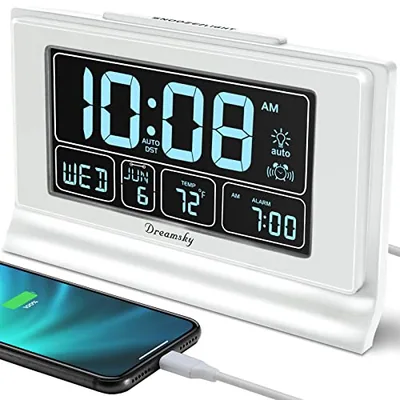
Both experiences are boring, which is the point of both technologies. The difference is only in how the boredom is manufactured: memory in one, radio in the other.
Time zones, travel and the second home
An auto-set clock treats a move between zones as one menu press: the preload carries every US zone, and switching from Eastern to Mountain re-aims the same stored time. For a clock that migrates to the summer cabin each June, that is a ten-second ritual.
Atomic stations handle the same move automatically once you tell them the zone, since WWVB broadcasts universal time and the zone setting localizes it. What neither technology does is guess the zone for you, a clock cannot know which side of a state line the nightstand sits on.
Hand-set models are, honestly, the most flexible travelers of all: any time, any offset, no assumptions. The vibrating travel clock leans on exactly that simplicity, plus auto-set convenience for its base zone.
The pattern across all three: zones are one deliberate human decision everywhere in our range. We would rather ask you once than guess wrong silently.
The sixty-second decision card
Want a bedside alarm you never think about? Auto-set model, pick your zone, done, the flagship hand-set clock is equally fine if you do not mind two button-presses a year at DST.
Want temperatures and a clock that corrects itself for years? Weather station, window placement, one patient night for WWVB, and the sensor-placement guide for the rest.
Want to never be surprised by a listing again? Remember one sentence: preloaded is memory, atomic is radio, and any product that will not tell you which it is has told you enough.